
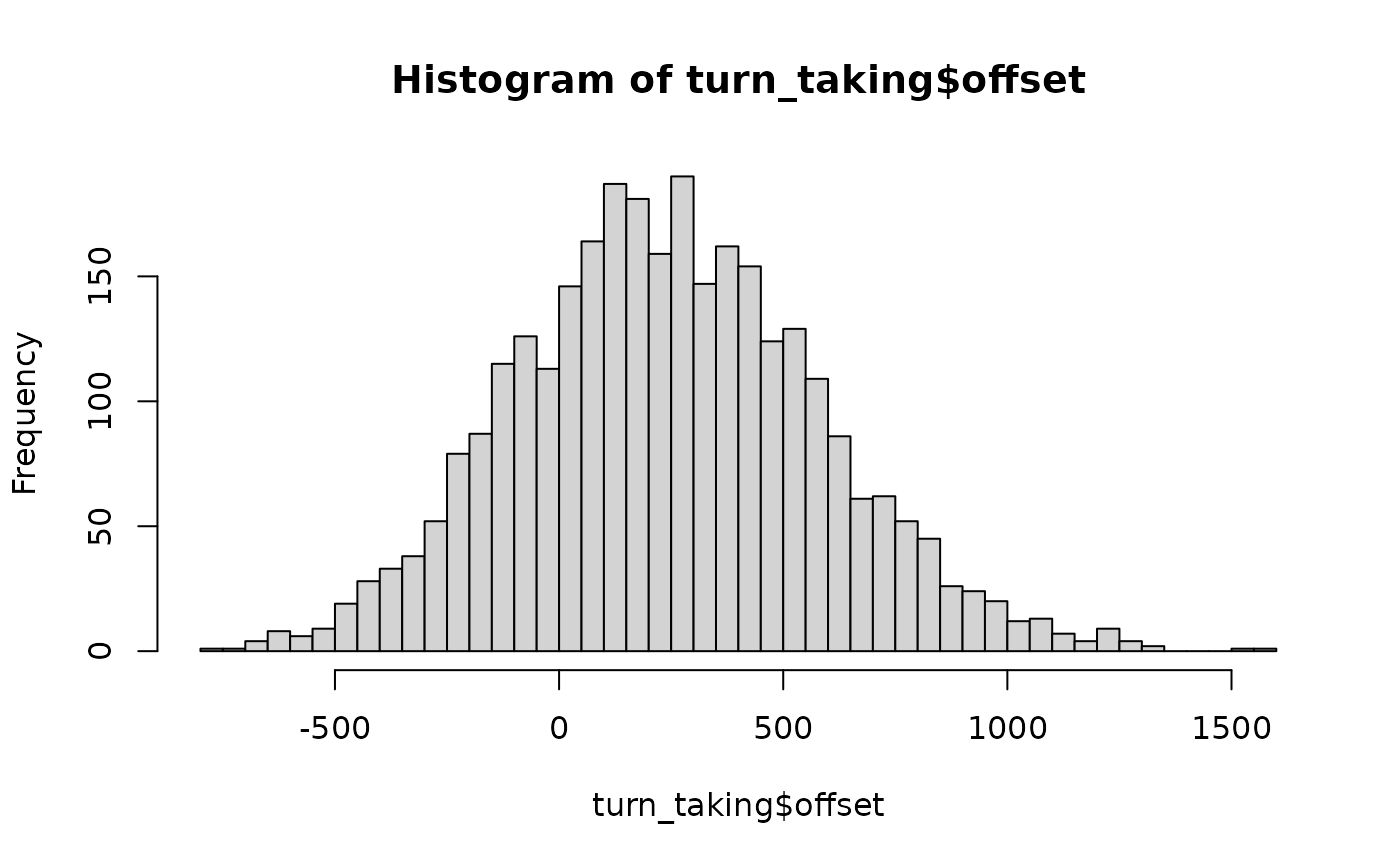
The gap between the end of a yes/no question and the start of its answer, in 25 question-answer pairs from each of 12 conversations in each of 10 languages. Negative values are overlaps. In every language, gaps cluster just above zero and are skewed to the right; languages differ in their average gap by a few hundred milliseconds. Disconfirmations and non-answers come later; answers to a questioner who is looking at the responder come sooner.
Format
A tibble with 3000 rows and 6 columns:
- language
Language, one of
"Danish","Dutch","English","Italian","Japanese","Korean","Lao","Tzeltal","Yélî Dnye"or"ǂĀkhoe Haiǁom".- conversation
Conversation ID: a three-letter code for the language and a number, from
akh_01toyel_12; 12 per language.- response
"confirmation"or"disconfirmation".- answer
"answer"or"non-answer"(e.g. I don't know).- gaze
Whether the questioner was looking at the responder,
"no"or"yes".- offset
Time from the end of the question to the start of the answer in ms.
Details
True model:
c0 is a by-conversation offset (SD 120 ms) and e is ex-Gaussian (a
normal with SD 200 ms plus an exponential with mean 150 ms, centred).
The three effects and the size of the conversation variation follow the
model in Stivers et al. (2009, Table 1). Baselines are set so that each
language's expected mean equals its reported mean: 7 ms for Japanese,
310 ms for Italian and 469 ms for Danish (Stivers et al. 2009), and the
others from
Levinson and Torreira (2015, Table 1). The conversations and answers are
simulated.
References
Stivers, T., Enfield, N. J., Brown, P., Englert, C., Hayashi, M., Heinemann, T., Hoymann, G., Rossano, F., de Ruiter, J. P., Yoon, K.-E. & Levinson, S. C. (2009). Universals and cultural variation in turn-taking in conversation. Proceedings of the National Academy of Sciences, 106(26), 10587-10592. doi:10.1073/pnas.0903616106
Levinson, S. C. & Torreira, F. (2015). Timing in turn-taking and its implications for processing models of language. Frontiers in Psychology, 6, 731. doi:10.3389/fpsyg.2015.00731
Examples
sort(tapply(turn_taking$offset, turn_taking$language, median))
#> Japanese Tzeltal Yélî Dnye English Korean
#> 11.0 47.0 103.0 178.0 207.0
#> Dutch Italian Lao Danish ǂĀkhoe Haiǁom
#> 229.0 302.0 417.5 462.0 475.0
hist(turn_taking$offset, breaks = 60)
 if (requireNamespace("lme4", quietly = TRUE)) {
m <- lme4::lmer(offset ~ response + answer + gaze + language + (1 | conversation),
data = turn_taking)
lme4::fixef(m)[c("responsedisconfirmation", "answernon-answer", "gazeyes")]
}
#> responsedisconfirmation answernon-answer gazeyes
#> 215.57395 111.65792 -82.41778