Participants judge Some of the cards have stars when all, some or none of the cards have stars. In the all-context the sentence is literally true but under-informative: a "false" response is pragmatic, a "true" response logical. Participants differ: some always answer one way, most mix the two. 60 participants, 24 items, three counterbalanced lists.
Format
A tibble with 1440 rows and 6 columns:
- participant
Participant ID,
P01toP60.- list
Counterbalancing list, 1 to 3.
- item
Item ID,
i01toi24.- context
How many cards have stars:
"some"(true control),"all"(critical) or"none"(false control).- response
"true"or"false".- rt
Response time in ms.
Details
True model: in the all-context, each participant answers "false" with their own probability, drawn from Beta(1.1, 0.7) (mean 0.61). Controls are answered correctly 96% of the time. Reaction times follow
where pragmatic marks a "false" response in the all-context, with
by-participant (SD 0.15) and by-item (SD 0.05) intercepts and residual
SD 0.25. The proportions follow Experiment 3 of Bott and Noveck (2004):
61% pragmatic responses, 9 of 32 participants who always gave the same
response, 87% to 98% correct on controls, slower pragmatic responses
and logical responses about as fast as controls. The effect sizes and
data are simulated.
References
Bott, L. & Noveck, I. A. (2004). Some utterances are underinformative: The onset and time course of scalar inferences. Journal of Memory and Language, 51(3), 437-457. doi:10.1016/j.jml.2004.05.006
Examples
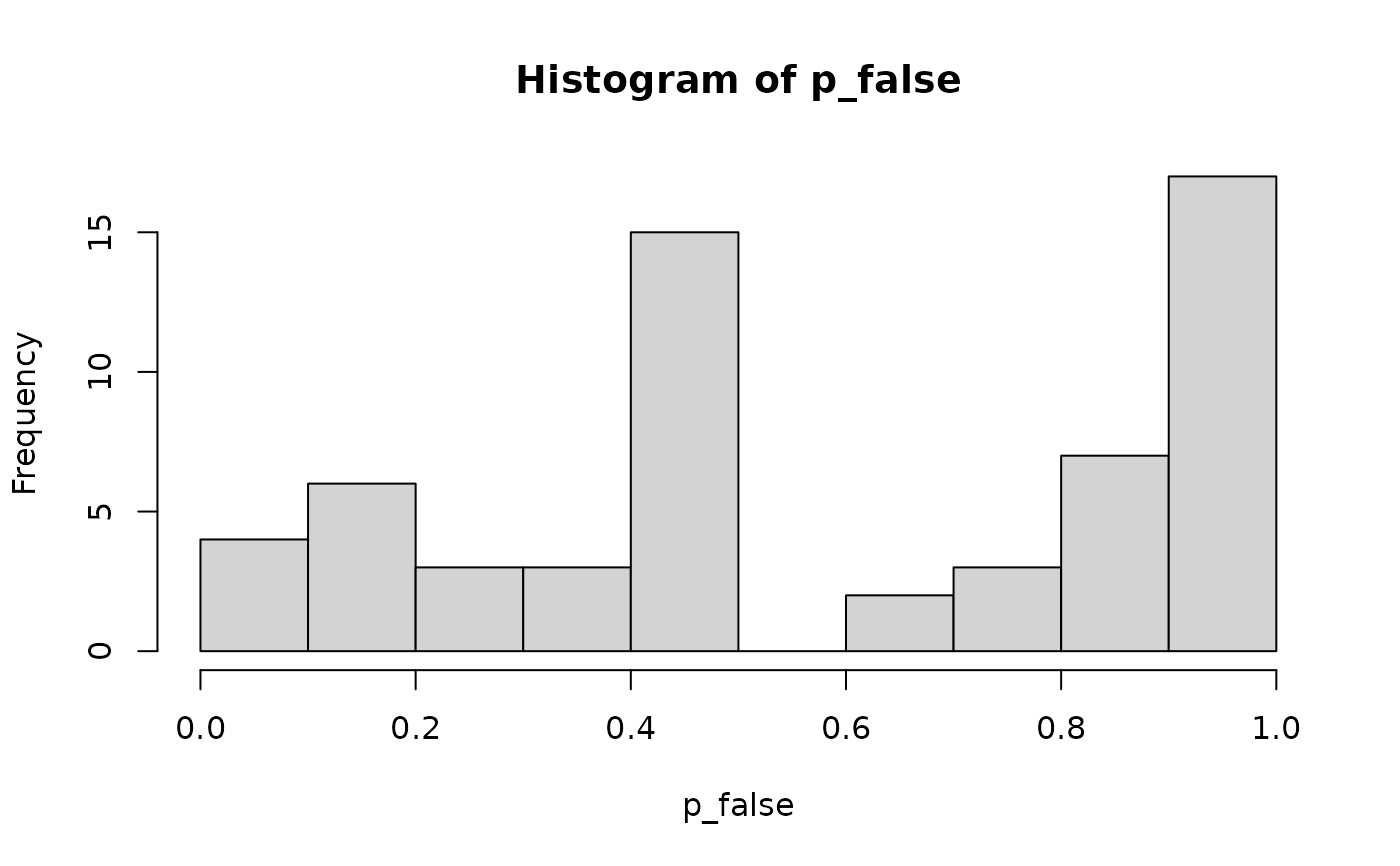
all_ctx <- subset(scalar_implicature, context == "all")
p_false <- tapply(all_ctx$response == "false", all_ctx$participant, mean)
hist(p_false, breaks = 10)
 controls <- droplevels(subset(scalar_implicature, context != "all"))
tapply(controls$response == "true", controls$context, mean)
#> some none
#> 0.96041667 0.03541667
aggregate(rt ~ response, data = all_ctx, FUN = median)
#> response rt
#> 1 true 1330.5
#> 2 false 1748.5