
%V, ΔC and VarcoV from 8 speakers of each of six languages: English, German, Greek, Italian, Korean and Spanish. Ramus et al. (1999) proposed %V and ΔC to sort languages into rhythm classes. Each speaker produced five samples of five kinds of material: uncontrolled sentences, sentences built from complex syllables, sentences built from simple syllables, a read story and spontaneous speech. The design follows Arvaniti (2012). The languages differ, but not in the way rhythm classes predict, and speakers, elicitation method and syllable complexity move the metrics about as much as language does. ΔC also falls as speech rate rises. For partitioning variance with mixed models.
Format
A tibble with 1200 rows and 8 columns:
- language
"English","German","Greek","Italian","Korean"or"Spanish".- speaker
Speaker ID: ISO 639-3 language code and number, e.g.
eng_01.- material
Kind of speech material. The three read sentence sets are
"uncontrolled sentences","complex-syllable sentences"and"simple-syllable sentences"; the other two levels are"story"and"spontaneous".- item
Sample number within speaker and material, 1 to 5.
- rate
Speech rate in syllables per second.
- percent_v
Percentage of the sample that is vocalic.
- delta_c
Standard deviation of consonantal intervals in ms.
- varco_v
Coefficient of variation of vocalic intervals.
Details
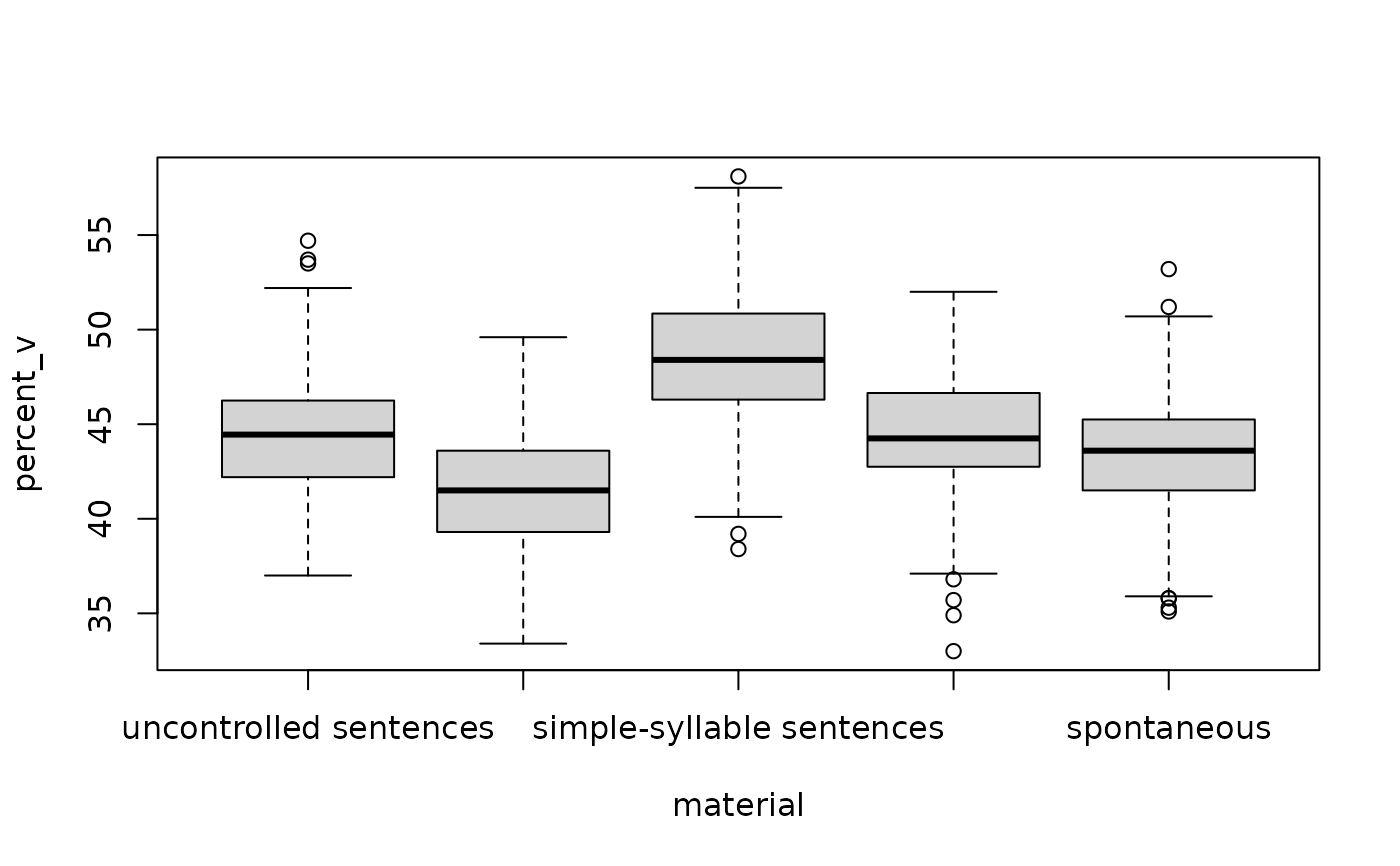
True model: each metric is the sum of a language mean, a material effect, a language-by-material deviation, a speaker effect and noise. Language means for %V, ΔC and VarcoV are 43, 51, 55 (English), 41.5, 51, 52 (German), 44.5, 46, 56 (Greek), 46, 46.5, 55 (Italian), 46, 49, 57.5 (Korean) and 46, 48.5, 54 (Spanish). They follow the order of the language differences Arvaniti (2012) found: for %V, German < English < Greek < Italian, Korean and Spanish; for ΔC, English and German > Korean and Spanish > Greek and Italian; for VarcoV, German lowest and Korean highest. Material effects, relative to the uncontrolled sentences, are -3, +7, +3 (complex-syllable sentences), +3, -6, -4 (simple-syllable sentences), -1, +2, +2 (story) and -1.5, +6, +7 (spontaneous). Language-by-material deviations have SD 1, 3 and 3, speaker effects SD 2, 4 and 4, and residuals SD 2, 5 and 6. ΔC falls by 6 ms per syllable per second, a rate effect described by Dellwo (2006). All values were chosen for the simulation to reproduce these patterns; they are not measurements from either study.
References
Arvaniti, A. (2012). The usefulness of metrics in the quantification of speech rhythm. Journal of Phonetics, 40(3), 351-373. doi:10.1016/j.wocn.2012.02.003
Dellwo, V. (2006). Rhythm and speech rate: A variation coefficient for deltaC. In P. Karnowski & I. Szigeti (eds.), Language and Language-Processing: Proceedings of the 38th Linguistics Colloquium, Piliscsaba 2003 (pp. 231-241). Frankfurt am Main: Peter Lang.
Rathcke, T. & Smith, R. (2015). Speech timing and linguistic rhythm: On the acoustic bases of rhythm typologies. Journal of the Acoustical Society of America, 137(5), 2834-2845. doi:10.1121/1.4919322
Ramus, F., Nespor, M. & Mehler, J. (1999). Correlates of linguistic rhythm in the speech signal. Cognition, 73(3), 265-292. doi:10.1016/S0010-0277(99)00058-X
White, L. & Mattys, S. L. (2007). Calibrating rhythm: First language and second language studies. Journal of Phonetics, 35(4), 501-522. doi:10.1016/j.wocn.2007.02.003
Examples
round(tapply(rhythm_metrics$percent_v, rhythm_metrics[c("material", "language")], mean),
1)
#> language
#> material English German Greek Italian Korean Spanish
#> uncontrolled sentences 42.8 42.8 45.3 43.7 45.9 46.3
#> complex-syllable sentences 38.6 40.3 42.0 41.8 43.0 43.4
#> simple-syllable sentences 46.4 45.7 48.2 49.7 48.9 52.1
#> story 41.8 42.8 45.5 44.9 44.7 46.7
#> spontaneous 41.9 41.2 44.2 43.5 44.0 45.3
boxplot(percent_v ~ material, data = rhythm_metrics)
 coef(lm(delta_c ~ rate + language + material, data = rhythm_metrics))["rate"]
#> rate
#> -6.414159
if (requireNamespace("lme4", quietly = TRUE)) {
m <- lme4::lmer(percent_v ~ language + material + (1 | speaker), data = rhythm_metrics)
round(lme4::fixef(m), 2)
lme4::VarCorr(m)
}
#> Groups Name Std.Dev.
#> speaker (Intercept) 2.0526
#> Residual 2.0880