
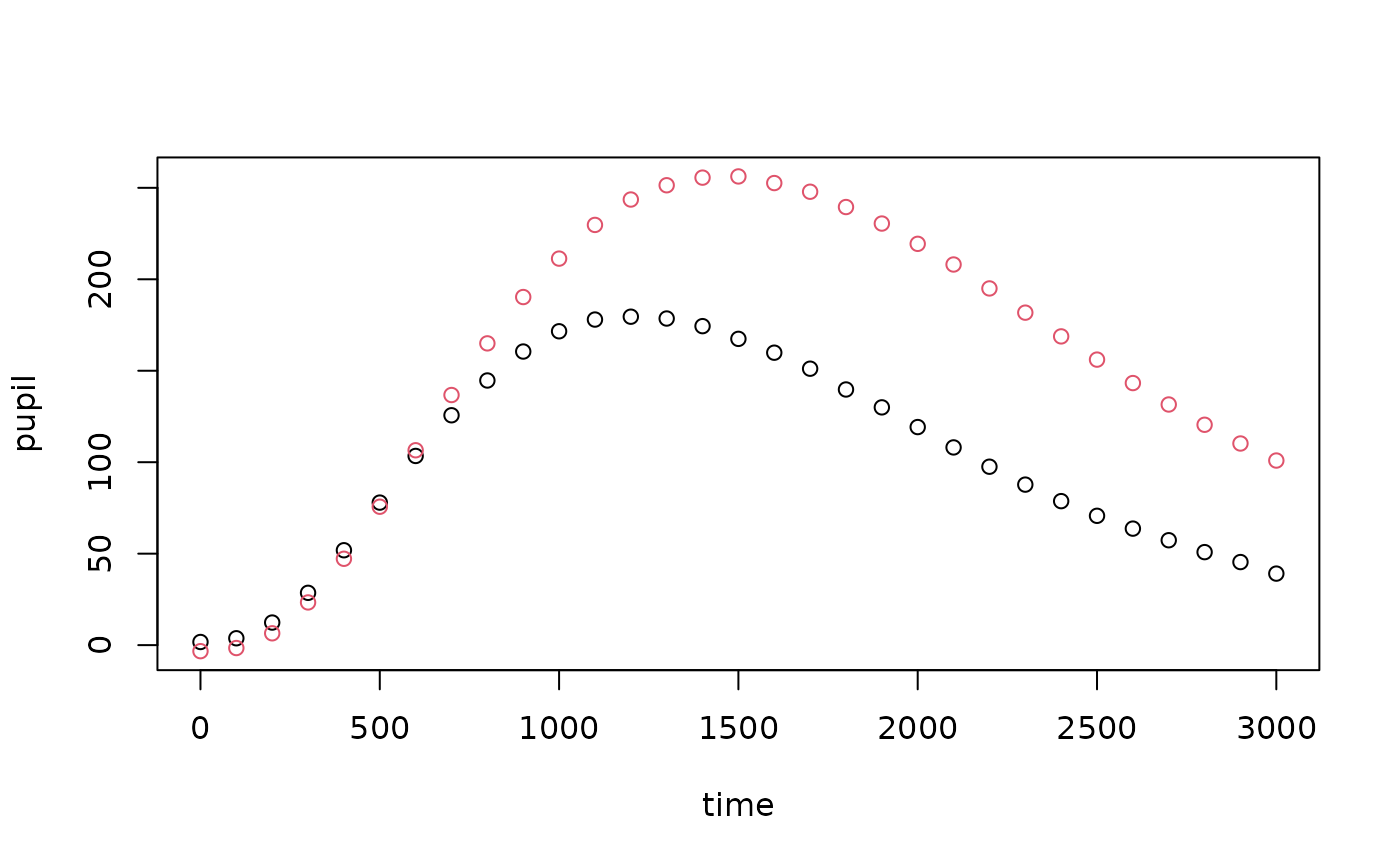
Pupil size over 3 seconds after stimulus onset, 12 trials per condition from each of 24 participants. Listening in noise leads to a larger and later peak. For GAMMs with autocorrelated residuals.
Format
A tibble with 17856 rows and 6 columns:
- participant
P01toP24.- condition
"quiet"or"noise".- trial
Trial number within condition, 1 to 12.
- trial_id
One level per trial (
participant.condition.trial).- time
Time from stimulus onset in ms, 0 to 3000 in steps of 100.
- pupil
Baseline-corrected pupil size, arbitrary units.
Details
True model: a gamma-shaped response peaking at 180 units after 1200 ms in quiet, and 90 units higher and 250 ms later in noise. The peak shrinks by 4 units per trial (habituation). By-participant variation in peak (SD 40), latency (SD 150 ms) and noise effect (SD 30); by-trial variation in peak (SD 40) and baseline (SD 15); residuals are AR(1) with rho 0.8 and innovation SD 12, so their SD is 20 (12 / sqrt(1 - 0.8^2)).
Examples
curve <- aggregate(pupil ~ condition + time, data = pupil_noise, FUN = mean)
plot(pupil ~ time, data = curve, col = condition)
 peaks <- do.call(rbind, lapply(split(curve, curve$condition),
function(d) d[which.max(d$pupil), ]))
peaks
#> condition time pupil
#> quiet quiet 1200 179.5469
#> noise noise 1500 256.2295