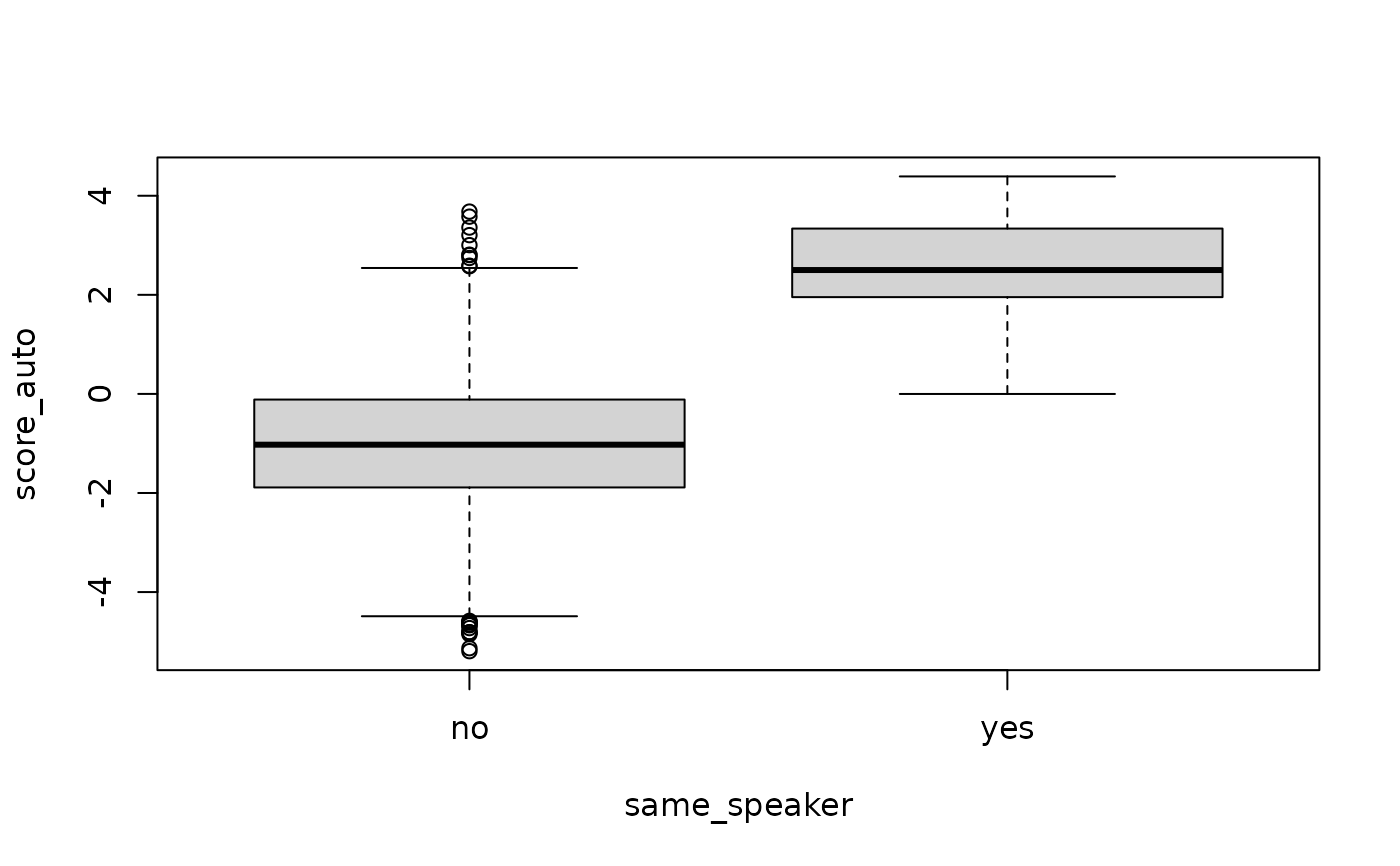
Scores from two systems comparing pairs of recordings of 80 male speakers of German: an automatic speaker recognition system and a formant-based system. Every speaker is compared with himself (same-speaker comparisons, recordings from two sessions) and with every other speaker (different-speaker comparisons). Higher scores mean more similar voices. For calibrating scores into likelihood ratios, computing Cllr and comparing or fusing systems.
Format
A tibble with 3240 rows and 6 columns:
- comparison
Comparison ID,
C0001toC3240.- speaker_a, speaker_b
The two speakers,
S01toS80.- same_speaker
"no"or"yes".- score_auto
Score of the automatic system.
- score_formant
Score of the formant-based system.
Details
True model: automatic scores are normal with mean 2.5 (SD 1) for same-speaker and -1 (SD 1.3) for different-speaker comparisons; formant scores have means 1 (SD 1) and -0.5 (SD 1.1). Each speaker shifts his scores by a speaker effect (SD 0.4 automatic, 0.3 formant; the mean of the two speakers in different-speaker comparisons). The automatic system discriminates much better: after logistic-regression calibration its Cllr is about 0.25, against about 0.7 for the formant system.
References
Brümmer, N. & du Preez, J. (2006). Application-independent evaluation of speaker detection. Computer Speech and Language, 20(2-3), 230-275. doi:10.1016/j.csl.2005.08.001
Examples
cllr <- function(score, same) {
  m <- glm(same ~ score, family = binomial)
  log_lr <- predict(m) - log(mean(same) / (1 - mean(same)))
  0.5 * (mean(log2(1 + exp(-log_lr[same]))) + mean(log2(1 + exp(log_lr[!same]))))
}
same <- forensic_comparison$same_speaker == "yes"
c(automatic = cllr(forensic_comparison$score_auto, same),
  formant = cllr(forensic_comparison$score_formant, same))
#> automatic   formant
#> 0.2531693 0.7061386
boxplot(score_auto ~ same_speaker, data = forensic_comparison)