
Parents of 60 children acquiring European Portuguese report each month, from 10 to 24 months, whether their child says each of 40 words. For each child and word, the data give the age at which the child first said the word, or 24 months if the child had not said it by the end of the study (a censored observation). Frequent words and nouns are learned earlier. For survival analysis.
Format
A tibble with 2400 rows and 6 columns:
- child
Child ID,
C01toC60.- word
Word ID,
w01tow40.- category
"noun","verb"or"other".- log_freq
log10 frequency of the word in child-directed speech.
- age
Age in months at first production, or 24 if censored.
- produced
1 if the child said the word by 24 months, 0 if censored.
Details
True model: a discrete-time hazard. In each month from 10 to 24
the probability of first saying a word is plogis(-5.2 + 0.28 * (age - 10) + 0.6 * (log_freq - 2) + category + c0 + w0), with category effects
0.5 (noun), -0.3 (verb) and -0.6 (other), by-child effects c0 (SD 0.6)
and by-word effects w0 (SD 0.4). About 37% of observations are
censored.
Examples
if (requireNamespace("survival", quietly = TRUE)) {
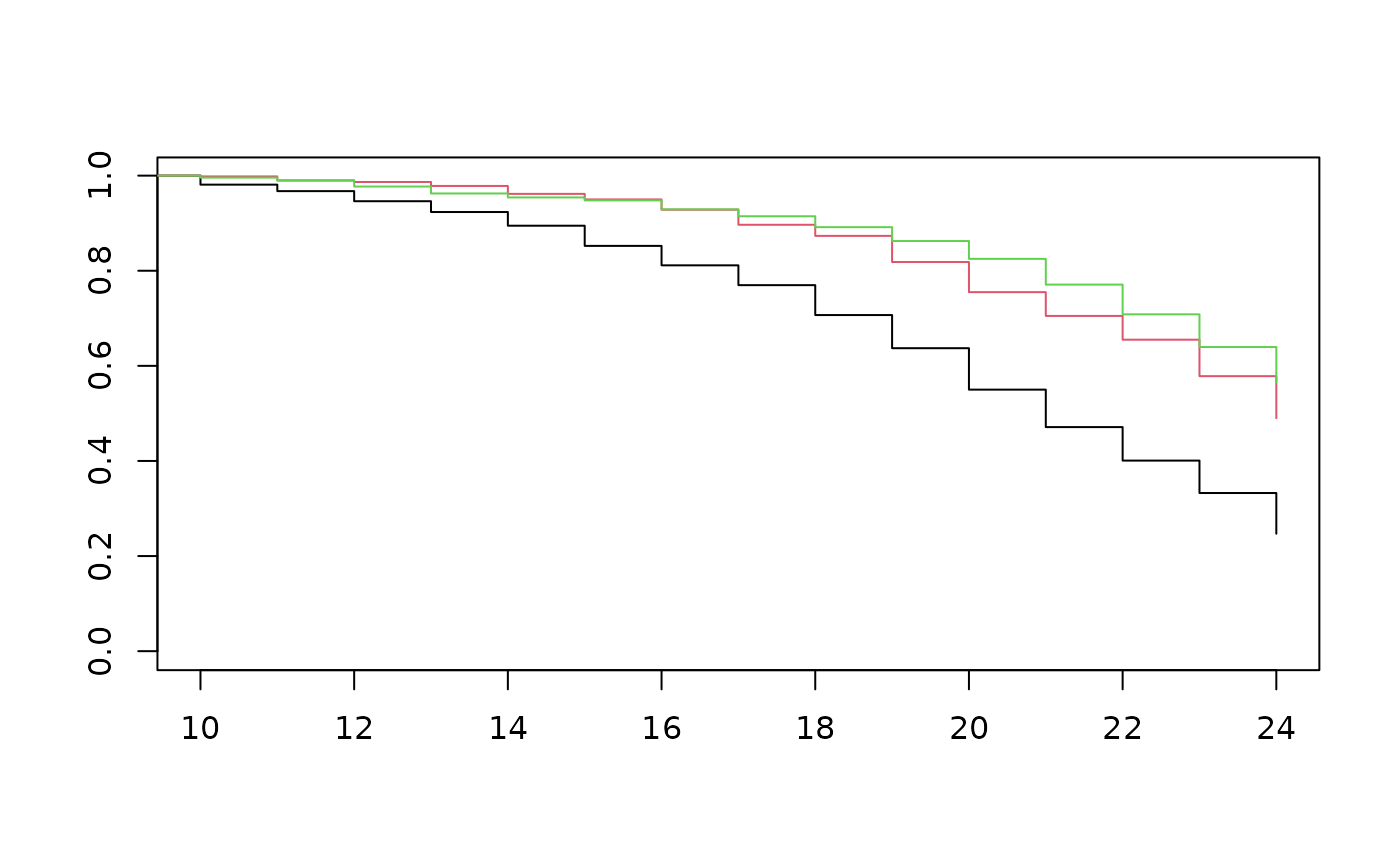
km <- survival::survfit(survival::Surv(age, produced) ~ category, data = first_words)
plot(km, col = 1:3, xlim = c(10, 24))
m <- survival::coxph(survival::Surv(age, produced) ~ category + log_freq +
survival::frailty(child), data = first_words)
coef(m)
}
 #> categoryverb categoryother log_freq
#> -0.6855188 -1.0264078 0.4688890