
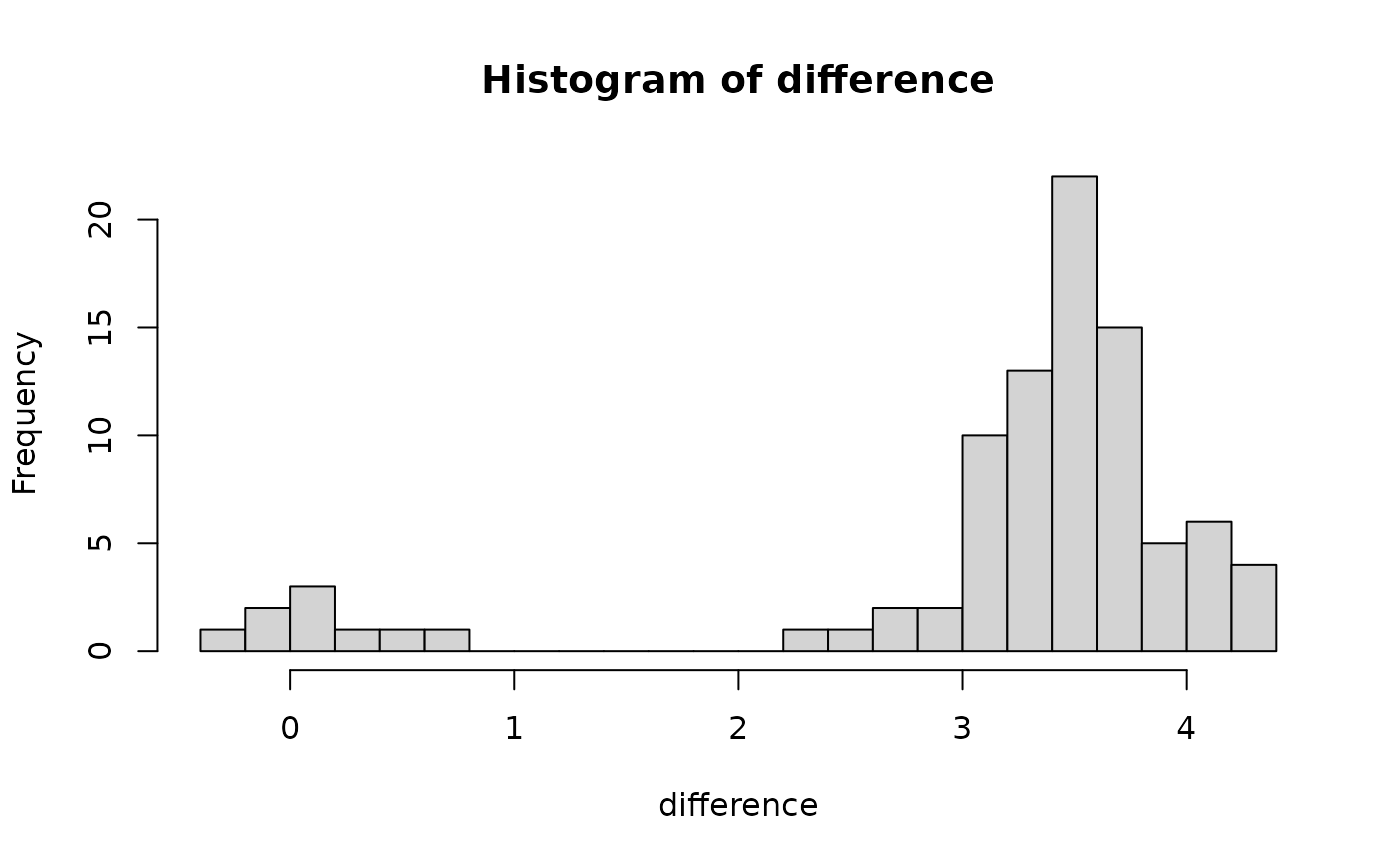
Hong Kong Cantonese has two rising tones, T2 (high rising, 25) and T5 (low rising, 23), which some younger speakers merge. 90 speakers, half aged 18 to 25 and half 26 to 74, each produce 10 T2 and 10 T5 words; the size of the f0 rise is measured in semitones. For a sound change in apparent time and for individual differences: mergers form a small, separate group of speakers, most of them young.
Format
A tibble with 1800 rows and 7 columns:
- speaker
S01toS90.- age
Age in years.
- gender
"female"or"male".- word
w01tow20.- tone
"T2"or"T5".- log_freq
log10 word frequency, 1 to 5; no effect.
- rise
f0 rise from onset to offset in semitones.
Details
True model: each speaker is a merger with probability
0.22 * plogis((30 - age) / 4), about 0.2 for speakers under 25.
Non-mergers rise by 7 semitones in T2 and 3.5 in T5; mergers by 5.4 and
5.0, so they keep a small difference. By-speaker intercepts have SD 0.6
and token SD is 0.9; word frequency and gender have no effect. Mok, Zuo
and Wong (2013) judged 28 of 169 students aged 18 to 22 to merge tones.
Their mergers still kept T2 and T5 slightly apart, and neither word
frequency nor gender made a difference. Because all their speakers were
young, the decline of merging with age is a design choice, and the
values and data are simulated.
References
Mok, P. P. K., Zuo, D. & Wong, P. W. Y. (2013). Production and perception of a sound change in progress: Tone merging in Hong Kong Cantonese. Language Variation and Change, 25(3), 341-370. doi:10.1017/S0954394513000161
Examples
rise <- tapply(cantonese_tone_merger$rise,
cantonese_tone_merger[c("speaker", "tone")], mean)
age <- tapply(cantonese_tone_merger$age, cantonese_tone_merger$speaker, unique)
difference <- rise[, "T2"] - rise[, "T5"]
hist(difference, breaks = 20)
 plot(age, difference)
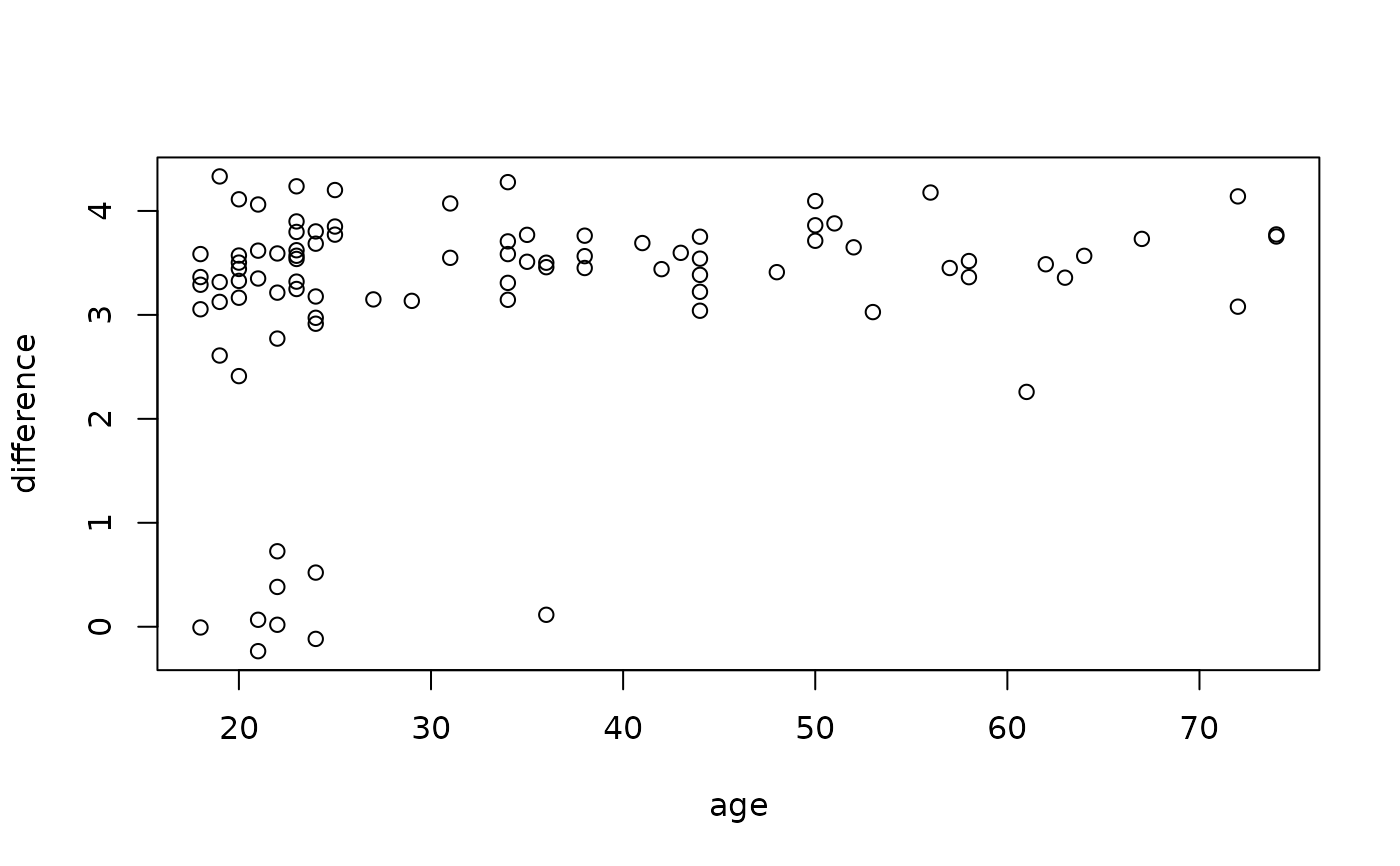 table(merger = difference < 2, under_40 = age < 40)
#> under_40
#> merger FALSE TRUE
#> FALSE 28 53
#> TRUE 0 9